Droven.io AI Automation: A Complete Guide for US Businesses
Artificial intelligence is transforming how businesses across the United States manage operations, serve customers, and improve productivity. From startups to large enterprises, companies are exploring smarter ways to reduce repetitive tasks and make better decisions. Droven.io AI Automation is a useful topic for understanding how modern technology supports business growth and digital transformation.
Through insights into AI automation tools, workflow automation, and business automation, readers can explore practical applications across different industries. However, successful automation requires more than choosing popular software. Businesses must understand their needs, compare available solutions, and consider costs, security, and employee readiness. This guide explores Droven.io and explains how AI automation for US businesses can improve everyday operations.
What Is Droven.io and What Does It Cover?
Droven.io is an editorial website focused on artificial intelligence, technology, and digital transformation. Its homepage describes it as a source of insights about AI, innovation, and modern business technology. Its categories include AI tools, generative AI, automation, cybersecurity, software development, analytics, and future technology.
The website is useful for readers seeking a Knowledge and education platform rather than a software dashboard. Its articles can support US business owners, technology professionals, and curious readers researching new developments. However, reading about automation and operating an automation system are two different activities.
Is Droven.io an AI Automation Tool or an Information Platform?
This distinction is important when researching Droven.io AI. Droven.io publishes educational articles and technology discussions. It is not itself a workflow builder where users connect applications, create triggers, or run automated business processes. Those activities require separate software products.
Its content can support Vendor-neutral research and early Pre-procurement research. Readers can explore different technologies before contacting Software vendors or purchasing subscriptions. Still, every product recommendation should be checked against its official documentation, current features, security terms, and pricing.
Who Can Benefit From Exploring Droven.io?
Different readers can use technology articles for different reasons. Business decision-makers may research automation opportunities, while CTOs can explore technical options and infrastructure requirements. Operations directors may focus on process improvements, reporting, and customer service workflows.
The website can also help readers understand unfamiliar terms before making purchasing decisions. For example, a business owner researching automated invoice handling may first learn how document extraction works. They can then compare tools that support the company’s accounting software.
What AI Automation Topics Does Droven.io Explore?
The site’s published categories cover several connected areas of modern technology. These include artificial intelligence, AI applications, generative models, business processes, and automation for work. Its dedicated AI Automation Work category discusses how automation can reshape workflows and support more efficient operations.
For readers researching Droven.io AI automation, these subjects create a broader learning path. They explain the technology behind automated tasks and show where businesses might apply it. The value comes from understanding the relationship between software, data, people, and business goals.
Artificial Intelligence and Generative AI
Artificial intelligence allows software to perform tasks that usually require human judgment or pattern recognition. Generative AI goes further by producing text, images, summaries, code, and other content. Businesses use these capabilities for research, customer communication, document review, and creative work.
However, generated content still needs suitable instructions and review. A marketing team might use an AI model to draft campaign ideas. An employee should still check facts, brand tone, legal claims, and customer details before publishing anything.
Workflow Automation and Robotic Process Automation
Workflow automation connects steps that move information between people and software. A new customer form might trigger a CRM record, notify a salesperson, and schedule a follow-up. Robotic Process Automation (RPA) uses software bots to repeat structured actions across digital systems.
Traditional automation follows clear rules, while intelligent automation can add document understanding or language processing. This difference matters when tasks involve messy information. A fixed rule can move a known field, but AI may help interpret an email written in different ways.
AI Tools and Business Applications
Modern AI automation tools support writing, research, data analysis, customer support, and application integration. Some products focus on one task, while others connect several business systems. A company should examine the actual workflow before choosing an AI automation platform.
For example, a small retailer may need automated order notifications rather than a complex AI agent. A larger company may need document extraction, approval routing, and audit records. The right choice depends on process complexity, data sensitivity, and the team’s technical skills.
Machine Learning, Cloud Computing, and Cybersecurity
Machine learning applications help software identify patterns in data and produce predictions. Retailers may forecast demand, while service companies may estimate customer churn. These systems depend on suitable data, ongoing monitoring, and a clear way to measure accuracy.
Automation also relies on dependable Cloud infrastructure. Businesses must consider access controls, backups, encryption, and system availability. Cybersecurity should be part of the design, not an afterthought added after a workflow begins handling customer or financial information.
Digital Transformation and the Future of Work
Digital transformation means changing how an organization operates through technology. It may involve replacing paper forms, connecting separate databases, or redesigning customer service. Automation can support this change, but software alone cannot repair unclear processes or poor management decisions.
The strongest results often come when companies review how work moves between departments. A sales team may collect customer details, while finance checks payment status. Connecting those steps can reduce delays and give employees a clearer view of each customer.
How AI Automation Is Transforming US Businesses

AI adoption in the United States is growing, although usage differs across industries and company sizes. The US Census Bureau reported that AI use hovered between 17% and 20% of businesses during its December 2025 to May 2026 observation period. It also found higher adoption among larger firms.
This growth does not mean every company has fully automated its operations. Many organizations are still testing tools or applying AI to limited tasks. The Federal Reserve also notes that adoption estimates vary depending on survey methods and what each survey counts as AI use.
The Growing Adoption of AI Across American Industries
The US AI automation market includes companies exploring AI for sales, finance, operations, software, and customer support. Adoption is not equal across every sector. The Census Bureau’s May 2026 analysis reported higher AI use in information and finance than in retail trade.
These differences often reflect available data, technical resources, and the nature of daily work. A software company may already use cloud systems and digital records. A small local retailer may rely on older point-of-sale tools and manual stock checks.
Reducing Manual Work and Improving Operational Efficiency
Business automation can reduce repeated tasks that consume employee time. For example, software can copy approved customer details into a CRM, create a service ticket, and notify the right team. This improves Operational efficiency when the workflow is reliable and properly maintained.
The goal should not be to remove every human step. Instead, companies can let software handle predictable work while employees manage exceptions. This approach can reduce Operational overhead and give staff more time for customer relationships, planning, and problem-solving.
Improving Customer Experiences With AI
Customers often expect quick answers and consistent service. AI chat systems can respond to common questions, collect basic details, and direct complex requests to human staff. These systems can also support Customer operations by organizing requests and identifying repeated service problems.
However, speed means little when an answer is wrong. Businesses should provide approved information, define escalation rules, and review conversations. A billing dispute or account-security issue may require a trained employee rather than an automated response.
Supporting Faster and More Informed Business Decisions
Companies collect information from sales records, website activity, inventory systems, and customer interactions. Predictive analytics can help identify patterns in this information. Managers may use forecasts to estimate demand, plan stock levels, or understand changes in customer behavior.
Reliable Data processing is essential for useful results. Duplicate records, missing values, and outdated information can weaken predictions. Before buying advanced analytics software, businesses should check whether their data is accurate, accessible, and organized.
AI Adoption Among Small and Large US Companies
Large companies often have dedicated technology teams and larger budgets. Smaller firms may need simpler products with clear pricing and minimal setup. The Census Bureau’s 2026 findings show that firms with more employees reported higher AI use than the smallest businesses.
This creates different starting points rather than one universal adoption path. A small accounting office might automate appointment reminders and document collection first. A national retailer may connect forecasting, inventory, customer service, and supplier systems across multiple locations.
Best Business Areas to Apply AI Automation
The most useful automation opportunities often appear in repetitive processes. These tasks follow recognizable steps and use information that employees enter or move between systems. AI automation for US businesses can support many departments, but each workflow needs a clear purpose and suitable safeguards.
A company should begin with a process that causes delays, errors, or unnecessary costs. It should then compare the current method with a proposed automated version. This practical approach makes Process selection easier and prevents teams from buying software simply because it sounds advanced.
Sales and Lead Generation Automation
Sales teams often receive leads through websites, advertising campaigns, phone calls, and email. Automation can collect these details, check required fields, and assign prospects to the right salesperson. Lead routing helps prevent inquiries from sitting unnoticed in a shared inbox.
AI can also support Lead enrichment by organizing available company or contact information. Yet businesses should verify data sources and follow applicable privacy rules. A useful system improves follow-up without sending irrelevant messages or making unsupported assumptions about prospects.
Marketing and Customer Relationship Management
Marketing teams manage campaigns, customer lists, landing pages, and follow-up messages. Automation can organize these activities and connect them with CRM records. CRM data entry becomes easier when approved customer details move between forms and business applications automatically.
AI can also help segment audiences and draft campaign variations. Still, marketers should review claims, audience targeting, and brand language. Automated campaigns need clear consent practices and unsubscribe controls, especially when they use personal information.
Customer Service and Support Operations
Customer service teams handle questions about orders, accounts, returns, and technical problems. AI can classify incoming messages and suggest suitable responses. Customer support ticket classification helps direct each issue to the correct department or support queue.
For example, a delivery question may go to the logistics team. A payment dispute may require finance staff. Automated routing works best when categories are clear and customers can reach a human when the system cannot resolve their problem.
Finance, Accounting, and Invoice Processing
Finance departments process invoices, receipts, purchase orders, and payment records. AI-based document tools can extract dates, supplier names, totals, and line items. This can speed up Invoice processing and support Accounts payable teams.
However, extracted figures should not automatically trigger every payment. Businesses can require approval for unusual amounts, new suppliers, or mismatched purchase orders. This keeps automation useful while reducing the risk of duplicate payments and fraudulent instructions.
Human Resources and Employee Management
HR teams manage applications, interviews, onboarding documents, leave requests, and employee records. Automation can schedule interviews, send reminders, and organize required forms. AI may also help answer routine policy questions using approved internal documents.
Sensitive employment decisions need extra care. Candidate screening and performance assessments can affect people’s opportunities. Companies should test systems for bias, protect employee information, and keep qualified staff involved in important decisions.
Inventory, Supply Chain, and Operations Management
Retailers and manufacturers need accurate information about stock, orders, and supplier activity. Automation can update inventory records when sales occur and alert staff when stock reaches a set level. Predictive models may help estimate future demand using historical sales and seasonal patterns.
These systems work best when information flows between sales, warehouse, and purchasing software. Poor data synchronization can create false stock levels. Businesses should test unusual situations such as returns, delayed deliveries, damaged goods, and sudden demand changes.
Software Development and IT Management
Software teams can use AI to draft code, explain errors, generate tests, and summarize technical documents. Automation can also create alerts when systems fail or services become unavailable. These tools can support Software development without replacing code review or security testing.
IT teams should restrict access to sensitive systems and review generated code carefully. AI can produce insecure or incorrect output. A developer remains responsible for checking dependencies, permissions, data handling, and production behavior before deployment.
AI Automation Tools and Technologies Businesses Should Understand
Different tools solve different problems. Some connect everyday applications, while others automate desktop actions or support complex AI workflows. A company’s Automation stack may combine several products, but every added system creates another integration and management responsibility.
Before selecting AI automation software, businesses should understand the main technology groups. This makes product comparisons more meaningful and helps teams avoid paying for features they will never use. The following table shows common categories and their typical roles.
| Technology | Main purpose | Example business use |
| No-code automation | Connect apps with visual workflows | Send form submissions to a CRM |
| Low-code automation | Build workflows with optional coding | Transform data between systems |
| RPA | Repeat structured screen-based tasks | Enter records into older software |
| AI agents | Handle multi-step tasks with defined tools | Research and prepare a support response |
| Machine learning | Find patterns and make predictions | Forecast product demand |
| Cloud platforms | Host and connect digital systems | Run workflows across departments |
No-Code and Low-Code Automation Platforms
No-code AI and visual automation tools help teams build workflows without writing much code. Low-code platforms add options for custom logic and technical control. These products can connect forms, spreadsheets, CRMs, email systems, and other business applications.
For example, a new website inquiry could create a CRM contact and notify a sales representative. The process may take only a few minutes to configure. However, teams still need to test duplicate submissions, missing fields, expired connections, and failed actions.
Robotic Process Automation Software
RPA bots perform structured actions through user interfaces or system connections. They can copy data, open records, fill forms, and move files. Businesses often consider RPA when older applications lack modern integrations or still require repetitive manual steps.
There are two common execution models. Attended and unattended bots describe whether a person starts or supervises the automation. Attended bots support employees during work, while unattended bots run scheduled or triggered tasks without constant user interaction.
AI Agents and Large Language Models
AI agents can interpret instructions, use connected tools, and complete several steps toward a defined goal. They differ from simple chatbots because they may take actions across software systems. Multi-step autonomous agents can plan tasks, retrieve information, and request further actions.
These systems often use LLM workflows to understand language and produce structured outputs. For example, an agent might review a support request, check an order record, and draft a response. Businesses should limit permissions and require approval before sensitive actions.
Machine Learning and Predictive Analytics Tools
Machine learning models learn patterns from historical examples. They can help estimate demand, detect unusual transactions, and identify customers who may stop using a service. Their predictions depend on training data, model design, and changing real-world conditions.
A forecast is not a guarantee. A sudden supply shortage or new competitor can make historical patterns less useful. Businesses should monitor model performance and compare predictions with actual results before allowing them to influence major decisions.
Cloud-Based and Self-Hosted Automation Systems
Managed platforms handle much of the hosting and maintenance for customers. They can reduce setup work and provide vendor-managed updates. In contrast, Self-hosted automation gives organizations more control over deployment and data location, but requires technical skills and ongoing maintenance.
The choice depends on security needs, internal expertise, and infrastructure costs. A small business may prefer a managed service. A company with strict data policies may evaluate self-hosting, private cloud options, or a hybrid approach.
Popular AI Automation Platforms Worth Exploring
The following products illustrate different approaches to automation. They are independent tools, not products operated by Droven.io. Their capabilities and plans can change, so businesses should verify current details directly with each provider.
| Platform | Main focus | Potential business use |
| Zapier | App connections and trigger-based workflows | Lead capture and notifications |
| Make | Visual automation and connected workflows | Multi-step marketing processes |
| n8n | Customizable workflows and self-hosting | Technical integrations and AI workflows |
| UiPath | RPA and enterprise process automation | Repetitive desktop and document tasks |
| Microsoft Power Automate | Cloud and desktop workflows | Microsoft 365 process automation |
| OpenAI API | AI features for custom applications | Summarization, classification, and language tasks |
Zapier describes its platform as a way to connect apps, data, and AI models. Make provides a visual environment for workflows and agents. n8n offers cloud and self-hosted deployment options, while Microsoft documents cloud and desktop flows. UiPath supports automation across robots, agents, and people.
How to Choose the Right AI Automation Tools for Your Business
Choosing software should begin with a business problem, not a product advertisement. A company may need faster customer replies, cleaner financial records, or fewer manual data transfers. A useful AI automation strategy connects each purchase to a measurable operational need.
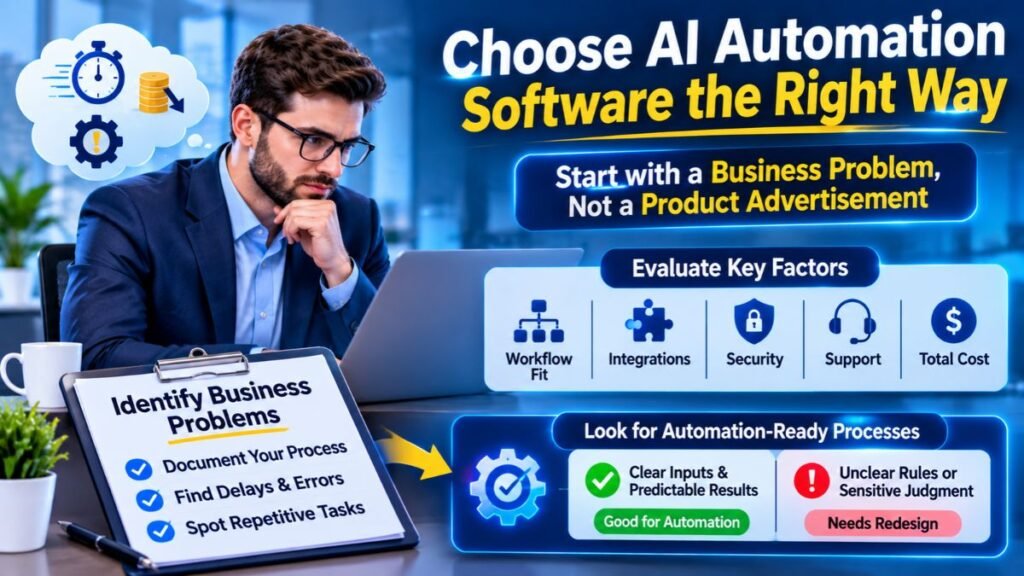
During AI evaluation, teams should compare workflow fit, integrations, security, support, and total cost. Tool comparisons are more useful when they examine the same business task across several products. This creates a fairer view than comparing feature lists without context.
Identify Business Problems Before Selecting Software
Start by documenting how a process works today. Record who performs each step, which systems they use, and where delays occur. Look for repeated tasks, frequent errors, and information that employees copy between applications.
This review helps establish Automation-ready processes. A task with clear inputs and predictable outcomes may be suitable for basic automation. A process involving unclear rules or sensitive judgment may need redesign before software can handle it safely.
Compare Features, Integrations, and Ease of Use
A tool should work with the applications the business already depends on. Check whether it supports the required CRM, accounting software, communication tools, and databases. Also review its API options, workflow limits, error logs, and available support.
Consider the people who will manage it. A visual builder may suit an operations team, while a custom API solution may require developers. The best fit depends on actual skills and process needs, not the number of features listed on a pricing page.
Evaluate Pricing, Licensing Models, and Total Costs
Software costs can include subscriptions, usage charges, extra users, API calls, storage, and support. A low starting price may rise as workflow volume increases. Review the Licensing model carefully and estimate costs at realistic usage levels.
Also include setup, training, maintenance, and integration work. These Implementation costs can be significant for complex projects. A company should compare the full cost over a suitable period rather than choosing a product based only on its monthly subscription.
Review Data Security, Privacy, and Compliance
Automation systems may handle customer names, payment details, employee records, and confidential documents. Businesses should examine encryption, access controls, data retention, audit logs, and vendor data practices. They should also check applicable federal and state requirements.
The NIST Generative AI Profile provides guidance for identifying and managing risks in generative AI systems. It can help organizations consider trustworthiness throughout design, development, use, and evaluation.
Calculate Automation ROI Before Making a Decision
Automation ROI compares the value created by a system with its total cost. A business might estimate saved labor hours, fewer processing errors, and faster customer responses. It should also include software fees, implementation, maintenance, and human review.
For a simple estimate, use this formula:
\[ \text{ROI}=\frac{\text{Annual Benefits}-\text{Annual Costs}}{\text{Annual Costs}}\times100 \]
The result depends on realistic assumptions. ROI benchmarks from another company may not match your workload, wage costs, or error rates. Use internal measurements whenever possible.
Test Tools Through Small Pilot Projects
A pilot lets a business test software on a limited workflow before wider adoption. Select one task with clear success measures, such as reducing invoice entry time. Compare results with the previous process and document errors.
The pilot should also test unusual cases. Check what happens when a file is missing, an application disconnects, or the AI returns an uncertain answer. A Vendor shortlist should include products that perform reliably under real working conditions.
7. How US Businesses Can Implement AI Automation Successfully
Successful AI implementation requires process design, suitable technology, and employee involvement. A company should understand its current workflow before automating it. Otherwise, it may simply make an inefficient process run faster and spread the same problems across more systems.
A practical Automation roadmap starts with a small project and expands after measurable results. It should define ownership, data access, testing, approval rules, and maintenance. This gives technical teams and business departments a shared plan.
Assess Existing Processes and Business Requirements
Map each step from the start of a task to its final result. Record the people, software, data, approvals, and exceptions involved. This helps identify bottlenecks and reveals whether the process is stable enough for automation.
The assessment also measures Process maturity. A mature process has clear rules, reliable information, and known responsibilities. If employees follow different methods for the same task, standardize the process before building an automated workflow.
Choose the Right Automation Strategy
Not every task needs advanced AI. A fixed notification may require only a simple trigger and action. A document workflow may need RPA and text extraction. A complex request may benefit from an AI model with carefully limited tools.
These Automation tiers help teams match technology to task complexity. Basic automation handles predictable steps, while intelligent systems interpret less structured information. The important decision is choosing the simplest approach that meets the business requirement.
Start With a Small Automation Pilot
Choose a task that happens often and has a clear result. For example, automate the process of collecting website inquiries and assigning them to sales staff. Measure response time, missing records, and manual corrections before and after the pilot.
Keep the first version narrow. Avoid connecting every department at once. A controlled pilot makes it easier to identify technical problems and collect employee feedback before the business commits more money.
Connect AI Automation With Existing Business Systems
Most companies already use several applications for sales, finance, communication, and operations. Automation connects these systems through integrations, APIs, or webhooks. Good connections reduce duplicate entry and help teams work with consistent information.
However, integrations need clear ownership and access rules. A workflow should not expose every customer record to every connected application. Technical teams should document permissions, data movement, failure handling, and recovery steps.
Train Employees and Establish Human Oversight
Employees need to understand what an automated system can and cannot do. Training should explain how to review results, report errors, and handle unusual situations. It should also make clear which decisions require a manager or specialist.
Human oversight is especially important for financial approvals, employment decisions, legal matters, and customer disputes. NIST guidance emphasizes managing risks across the AI lifecycle rather than treating safety as a final software check.
Monitor Performance and Expand Gradually
Once a workflow goes live, track its performance over time. Monitor completion rates, errors, processing time, user feedback, and operating costs. Review failed runs and update the process when business rules or connected applications change.
Expansion should follow evidence. If a pilot reduces delays without creating new risks, consider applying the same design elsewhere. If the results are weak, fix the process or reconsider the tool before increasing its scope.
Build a Long-Term AI Automation Roadmap
A roadmap connects individual projects to wider business goals. It should identify priority workflows, owners, budgets, technical dependencies, and review dates. It should also explain how the company will manage changes as systems and regulations evolve.
This plan helps Engineering teams coordinate with finance, operations, and department leaders. It also prevents disconnected projects from creating a confusing technology environment. A clear roadmap makes future upgrades easier to assess and manage.
Benefits and Challenges of AI Automation for Businesses
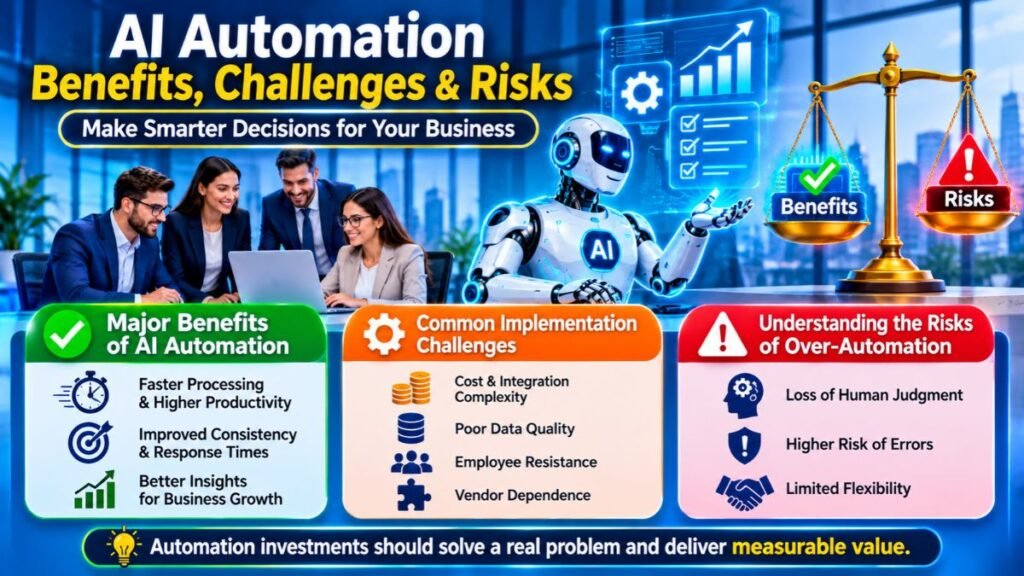
AI can help companies process information faster and reduce repetitive work. It may also improve consistency, customer response times, and access to business insights. However, benefits depend on data quality, workflow design, employee training, and ongoing system management.
Companies should weigh these gains against cost, security, and operational risks. Automation investments should solve a real problem and produce measurable value. A system that saves time but creates frequent errors may not improve the business overall.
Major Benefits of AI Automation
Automation can reduce manual data entry and move routine requests through established processes. It can also help employees find information and prepare reports more quickly. When designed well, these improvements support productivity without removing human responsibility.
Businesses may also gain better visibility into their operations. Connected systems can show where requests wait, which tasks fail, and how long work takes. These insights help managers improve processes rather than relying only on assumptions.
Common AI Automation Implementation Challenges
Implementation can involve software fees, integration work, training, and technical support. Poor data can reduce accuracy, while unclear rules can cause workflows to fail. Employees may also resist systems they do not understand or trust.
Vendor dependence is another concern. A provider may change its pricing, features, or service terms. Businesses should review export options, data ownership, service reliability, and exit plans before placing critical operations inside one platform.
Understanding the Risks of Over-Automation
Automating every task can create new problems. Some situations require empathy, context, negotiation, or expert judgment. An AI system may misunderstand a customer complaint or misread an unusual financial document.
High-impact decisions need stronger controls. Companies should define which actions software can complete alone and which require approval. They should also provide a clear path for correcting mistakes and escalating uncertain cases.
Balancing Automation and Human Oversight
The strongest approach combines software speed with human judgment. Systems can collect information, organize records, and suggest next steps. Employees can review exceptions, approve sensitive actions, and handle cases that need personal attention.
This balance also improves accountability. A business should know who owns each workflow and who can stop it. Logs, approval records, and regular reviews make it easier to understand what happened when something goes wrong.
Measuring the Real Business Value of Automation
A useful measurement plan compares the process before and after automation. Track time per task, error rates, customer satisfaction, and operating expenses. Include the time employees spend checking AI output because review work affects the real savings.
Annual automation ROI should include both direct and indirect costs. A project may save labor hours but require more software support. The final calculation should reflect actual performance rather than optimistic estimates.
Future of AI Automation and Emerging Technology Trends in the USA
The next phase of AI automation in the USA will likely involve more connected systems and tools that can complete multiple steps. AI agents are gaining attention, but many organizations are still experimenting or piloting them. McKinsey’s 2025 survey found that most respondents had not yet scaled AI across their enterprises.
This means businesses should prepare carefully rather than rush into autonomous systems. Better data, clear permissions, and strong process design will remain important. The future will not depend only on smarter models; it will also depend on how responsibly companies use them.
The Rise of Agentic AI and Autonomous Workflows
Agentic systems can plan and perform several actions toward a defined goal. They may search internal information, use connected applications, and prepare work for approval. Agentic AI workflows can support tasks that involve more than one tool or decision point.
McKinsey’s 2025 survey reported that 62% of respondents said their organizations were at least experimenting with AI agents. Yet enterprise-wide scaling remained limited. This suggests the technology is developing quickly, while reliable deployment still requires careful testing.
Hyperautomation and Connected Business Systems
Hyperautomation combines several technologies, such as workflow software, RPA, AI, and system integrations. Its purpose is to connect processes across departments rather than automate isolated tasks. A customer order, for example, may trigger inventory checks, payment updates, and delivery notifications.
This approach can improve visibility, but it also increases technical complexity. Businesses need clear system ownership and consistent data rules. Without those foundations, connected workflows can spread errors across multiple applications.
More Accessible AI Automation for Small Businesses
Cloud software and visual builders are making automation easier to explore. Small companies can begin with appointment reminders, customer follow-ups, or document collection. They do not always need a large development team or custom infrastructure.
However, accessibility does not remove the need for planning. Business owners should understand usage limits, data handling, support options, and recurring fees. A simple workflow that works consistently may be more useful than an advanced system nobody can maintain.
AI-Powered Analytics and Predictive Business Decisions
Predictive tools can help businesses estimate demand, identify unusual activity, and understand customer patterns. As more systems share reliable data, managers may gain a clearer view of operations. This can support planning across sales, finance, inventory, and customer service.
Predictions should remain decision support rather than unquestioned instructions. Models can become less accurate when markets change or data quality declines. Regular testing helps businesses detect these shifts before they cause costly mistakes.
Cybersecurity, Governance, and Responsible AI Adoption
As automation gains access to more systems, security becomes more important. Companies should restrict permissions, protect sensitive data, monitor activity, and review third-party providers. They should also establish rules for storing and using AI-generated information.
The NIST AI Risk Management Framework offers a structured way to think about trustworthy AI. Its generative AI profile discusses risks that organizations should consider when designing, evaluating, and using these systems.
How US Businesses Can Prepare for the Next Automation Wave
Preparation starts with good records and clear processes. Businesses should train employees, review their technology systems, and identify tasks that can benefit from automation. They should also create rules for testing, approval, monitoring, and incident response.
A flexible technology plan is more useful than chasing every new release. Companies can review tools as their needs change and replace systems when better options become available. The strongest foundation is a workforce that understands both the benefits and limits of AI.
Frequently Asked Questions
What Is Droven.io AI Automation?
Droven.io covers artificial intelligence, automation, technology, and digital transformation through educational articles. It helps readers explore these topics but is not itself an automation software product.
Is Droven.io an AI Automation Software Platform?
No. Droven.io is an editorial website. Businesses need separate software products to build and run automated workflows.
Does Droven.io Offer Free AI Automation Tools?
Droven.io publishes information about AI and technology. Readers should check individual third-party providers for free plans, trials, and product access.
What AI Automation Topics Does Droven.io Cover?
Its categories include AI tools, generative AI, automation for work, AI business processes, analytics, cybersecurity, and digital transformation.
Which AI Automation Tools Are Suitable for Small US Businesses?
The right product depends on workflow needs, budget, integrations, and technical skills. Zapier, Make, n8n, and Microsoft Power Automate are examples worth evaluating for different automation requirements.
How Can a Business Start Using AI Automation?
Start with one repetitive process that has clear steps and measurable results. Test a suitable tool, review its output, and expand only after the workflow performs reliably.
Is AI Automation Worth It for Small Businesses in the USA?
It can be valuable when it reduces meaningful costs, delays, or errors. Businesses should calculate total expenses and compare them with actual savings before making a larger investment.
Conclusion:
Droven.io AI automation is a useful subject for businesses researching artificial intelligence and modern technology. The website covers topics that can help readers understand automation, AI applications, and digital transformation. Its educational content can support early research, but businesses must evaluate actual software separately.
For US companies, successful automation starts with a clear business problem. Choose suitable tools, protect sensitive information, train employees, and measure results. Start small, learn from real performance, and expand only when the benefits justify the cost.