10 Best LangChain Alternatives in 2026 for Building AI Agents
Choosing the right AI development framework can make building intelligent applications much easier. While LangChain offers powerful tools for connecting language models, data sources, and external services, it may not suit every developer or project. Some teams need simpler workflows, better control over agents, or specialized tools for document search and automation. Fortunately, several LangChain alternatives provide different approaches to modern AI agent development. Options such as Llama Index, Careway, Haystack, and Microsoft Agent Framework support different development needs. Some focus on Retrieval-Augmented Generation (RAG), while others simplify Multi-agent systems and workflow management. This guide explores the 10 best LangChain alternatives in 2026, comparing their features, strengths, limitations, and use cases to help you choose confidently.
What Is LangChain and How Does It Work?
LangChain is an open-source framework for building applications with large language models (LLMs). It connects models with tools, external data, and application logic. Developers can use it to create catboats, research assistants, document search systems, and automated agents.
Instead of writing every connection from scratch, developers use reusable components. These components support Model integrations, prompts, tools, retrieval, and structured responses. LangChain supports Python and JavaScript/Typescript development, making it useful across different application environments.
Key Features of LangChain
LangChain provides components for connecting models with external services and application data. Its integrations support different Model providers, including Open-air, Anthropic, and other compatible services. Developers can also connect databases, APIs, search tools, and custom functions.
Its agent capabilities let models decide when to use available tools. Through Tool calling and Function calling, an agent can retrieve information, perform calculations, or interact with another system. Developers can also define structured outputs and control how an application handles model responses.
LangChain also supports retrieval-based applications. Developers can prepare documents, create embedding’s, and connect retrieval systems. These features help build AI-powered applications that answer questions using private or external information instead of relying only on model training data.
Common LangChain Use Cases
A common use case is a customer support assistant that searches product documentation before answering questions. Another example is an internal research assistant that collects information from several sources. LangChain can also connect business applications and automate tasks that require multiple model interactions.
For document-based applications, developers can use Document processing, retrieval, and Semantic search to find relevant information. A Chabot might search company policies before answering an employee’s question. A sales assistant could retrieve customer details before preparing a follow-up message.
Who Should Use LangChain?
LangChain can suit developers who need broad integrations and reusable components. It is useful for Python developers, JavaScript engineers, startups, and enterprise teams. It can support simple language-model applications as well as more complex agent workflows.
However, a large ecosystem doesn’t automatically make a framework suitable for every project. Some teams may prefer a smaller library with fewer abstractions. Others may need a specialized solution for retrieval, strict data validation, or visual workflow design.
Why Are Developers Looking for LangChain Alternatives?
LangChain offers many useful features, but development requirements differ between projects. Some developers want more direct control over agent behavior. Others need simpler APIs, specialized retrieval tools, or a framework that fits their existing programming environment.
The growth of AI agent frameworks has also created more choices. Developers can now select tools built around particular models, cloud platforms, or application types. This makes comparing LangChain alternatives a practical step before starting a new project.
Complex Learning Curve
A framework becomes difficult to learn when developers must understand many connected concepts before building a working application. LanglangchaChain includes integrations, prompts, agents, retrievers, tools, and other components. New developers may need time to understand how these pieces work together.
The challenge can grow when an application combines several components. A developer might need to understand model behavior, retrieval, memory, and orchestration at the same time. A focused framework can sometimes reduce this learning effort by providing a narrower set of features.
Debugging and Observability Challenges
AI agents can fail in ways that ordinary software often doesn’t. A model may return a confident but incorrect answer instead of producing a clear error. It may also select an unsuitable tool or repeat an action without making useful progress.
This makes AI debugging different from traditional debugging. Developers need to inspect prompts, model responses, tool calls, and intermediate decisions. Trace-based debugging helps reveal the sequence of events behind a result, while LLM observability helps teams understand behavior across many interactions.
Performance and Scalability Requirements
A prototype may work well with a few requests but struggle under real workloads. More users can increase model calls, network requests, token usage, and database activity. These factors affect response time and operating costs.
Production systems also need concurrency controls and reliable state management. Developers may need persistent sessions, retries, timeouts, and background processing. A suitable AI agent runtime can help manage these requirements, but teams should test performance under realistic workloads.
Limited Flexibility for Specific Projects
A general-purpose framework may include features that a small application never uses. A document search product, for example, may need advanced indexing and retrieval more than broad agent orchestration. A Typescript application may also benefit from tools designed around its existing ecosystem.
Specialized frameworks can provide a more direct development experience. Llama Index focuses on data and retrieval workflows, while PydanticAI emphasizes typed Python agents. Choosing a focused tool can reduce unnecessary complexity when its design matches the project.
Deployment and Production Management
Moving an agent from a local environment to production introduces new responsibilities. Developers must consider hosting, authentication, data protection, monitoring, and failure recovery. A working demonstration does not prove that an application can handle real users safely.
Teams also need a plan for Production deployment and Agent deployment. This may involve containers, cloud services, databases, secrets management, and logging. Some frameworks provide integrations for these tasks, while others expect developers to assemble the production environment themselves.
Cost and Infrastructure Considerations
The framework itself is only one part of an application’s total cost. Model usage, embedding generation, vector storage, hosting, monitoring, and data processing can all affect the budget. A free library can still support an expensive application.
Developers should compare the complete cost of running an agent. They should also check whether a platform charges per user, request, execution, or resource. This matters especially when choosing managed services for teams with growing workloads.
What to Look for When Choosing a LangChain Alternative
Choosing a framework should begin with the application rather than a popularity ranking. A document assistant has different needs from a customer service agent or a multi-agent research system. The right choice should support the required tasks without adding unnecessary development work.
Compare language support, model compatibility, retrieval, orchestration, security, and deployment. Also examine documentation, community activity, licensing, and maintenance. These factors help reveal whether a tool can support both the first prototype and the application’s future growth.
Programming Language Compatibility
Start by checking which languages the framework supports. Python has a broad ecosystem for data science and machine learning. TypeScript is common in web development, while .NET is widely used in many enterprise environments.
A Python framework may fit a team that already uses Python for data pipelines and backend services. A TypeScript library may be more convenient for a web product built with Node.js. Language compatibility can reduce integration work and make maintenance easier.
AI Agent Development Capabilities
An agent framework should support the level of autonomy your application requires. A simple assistant may only need one model and a few tools. A complex system may require multiple agents, shared state, conditional steps, and approval checkpoints.
Examine how the framework handles Agent state management, tool execution, and Multi-agent coordination. Also check whether it supports Short-term memory for current conversations and Long-term memory for information that must persist across sessions.
RAG and Data Integration
Applications that answer questions from private documents need a reliable retrieval pipeline. Check how a framework handles file ingestion, chunking, embeddings, indexing, and search. These stages influence whether the model receives useful context before generating an answer.
Also examine support for Vector databases and external data sources. A good retrieval setup should return relevant information and preserve useful source references. Poor retrieval can lead to inaccurate answers even when the language model performs well.
Model Compatibility and Integrations
Model choice affects quality, speed, cost, and available capabilities. Some projects need one provider, while others require the freedom to switch between models. Check whether the framework supports the providers and model features your application needs.
Strong API integrations can also reduce custom development. Look for support for tool servers, databases, search services, and business platforms. Standards such as the Model Context Protocol (MCP) can make it easier to connect agents with compatible external tools.
Deployment, Security, and Scalability
Production agents need clear security boundaries. They may access customer records, internal documents, payment systems, or business APIs. Developers should understand how the framework handles permissions, secrets, approvals, and untrusted input.
Pay particular attention to Prompt injection, which occurs when malicious instructions attempt to influence an AI system through its input or retrieved content. Sensitive tasks may also require Secure code execution, Isolated execution environments, and careful Credential management.
Pricing and Open-Source Availability
Check the framework’s license before using it in a commercial product. An open-source license may allow broad use, but its exact terms still matter. Also separate the cost of the framework from optional hosting, monitoring, and managed services.
Some projects provide a free core library and charge for hosted infrastructure or enterprise features. Others use usage-based cloud pricing. Review current pricing pages and estimate costs using realistic request volumes rather than relying on a free-tier label.
Types of LangChain Alternatives and Their Differences
Not every competing product solves the same problem. Some tools provide general agent development features, while others focus on retrieval or visual workflow design. Understanding these categories makes it easier to compare tools with similar purposes.
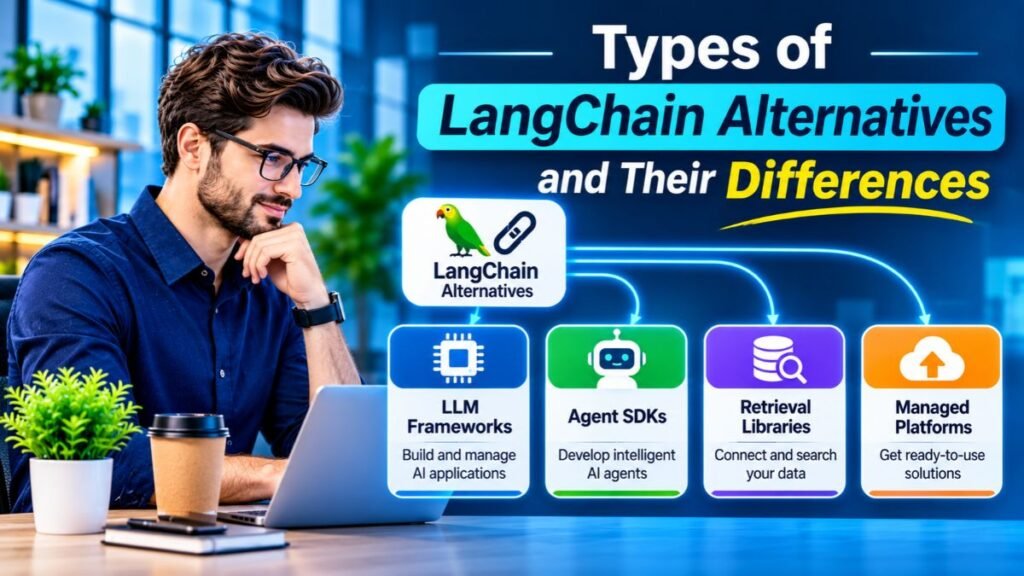
The broader ecosystem includes LLM frameworks, agent SDKs, retrieval libraries, and managed platforms. Some products cover more than one category. Their differences often involve how much control they provide and how much infrastructure developers must manage.
AI Agent Development Frameworks
Agent development frameworks provide components for creating agents that use models and external tools. They may include instructions, tool definitions, memory, state, and execution controls. Developers use them to build assistants that can perform several connected tasks.
CrewAI, Microsoft Agent Framework, Google ADK, and OpenAI Agents SDK fit this broad category. Their designs differ, so developers should compare how each handles delegation, workflows, model choice, and production needs.
Retrieval-Augmented Generation (RAG) Frameworks
Retrieval-Augmented Generation (RAG) connects a language model with an external knowledge source. The application searches for relevant information and gives that context to the model. This approach can help answer questions about documents or information that wasn’t included in model training.
LlamaIndex and Haystack provide tools for building retrieval-focused applications. Their capabilities include data ingestion, indexing, retrieval, and pipeline development. These frameworks can also support agents that need to search information before taking action.
No-Code and Low-Code AI Workflow Platforms
Visual platforms let users build AI applications through graphical interfaces. Instead of writing every component in code, users connect models, data sources, and actions through workflow builders. This can help teams test ideas without building a complete backend first.
Dify and Flowise are examples of this approach. They support visual development and can expose applications through APIs. However, complex requirements may still need custom code, infrastructure knowledge, and careful testing.
Cloud-Based AI Development Platforms
Cloud platforms combine model access with managed infrastructure and deployment tools. They can reduce the work involved in hosting and maintaining an agent. They may also connect with identity systems, databases, monitoring services, and enterprise controls.
Microsoft’s AI ecosystem and Google Cloud provide options for teams already using their platforms. These environments can be useful when an organization needs centralized administration. However, developers should examine usage costs and platform dependencies before committing.
LLM Orchestration and Application Development Tools
Orchestration tools coordinate the steps that make an AI application work. They may manage model calls, tool execution, branching, retries, and handoffs between agents. This is important when a task requires more than one response from a model.
Workflow orchestration can be simple or highly structured. A basic application may use a few sequential steps. A complex application may need persistent state, parallel tasks, approval stages, and recovery after interruptions.
10 Best LangChain Alternatives in 2026
The following tools cover different parts of AI agent development. Some are code-first frameworks, while others provide visual application builders. They are compared by their main purpose, capabilities, strengths, limitations, and typical cost considerations.
The comparison focuses on practical fit rather than claiming that one framework wins every category. Features and pricing can change during the year. Always check official documentation and licensing before selecting a tool for production.
| Alternative | Main focus | Common use case | Development approach |
| LlamaIndex | Data and retrieval | Document-based agents | Code-first |
| CrewAI | Agent teams | Collaborative task workflows | Code-first |
| Haystack | Search and RAG | Knowledge assistants | Code-first |
| Microsoft Agent Framework | Enterprise agents | Microsoft-based systems | Code-first |
| Google ADK | Agent development | Google Cloud applications | Code-first |
| OpenAI Agents SDK | Agent execution | Tool-using assistants | Code-first |
| Mastra | TypeScript agents | Web and backend applications | Code-first |
| Dify | AI applications | Visual workflow products | Low-code |
| Flowise | Visual orchestration | Drag-and-drop AI workflows | Low-code |
| PydanticAI | Typed Python agents | Structured AI applications | Code-first |
1. LlamaIndex – Best for Data-Centric RAG Applications
LlamaIndex is a framework for connecting language models with external data. It helps developers load, organize, index, and retrieve information from documents and other sources. This makes it useful for knowledge assistants, research tools, and applications built around private datasets.
Its components support document ingestion, indexing, query engines, and agent workflows. Developers can connect data sources and build retrieval pipelines around their needs. LlamaIndex is particularly relevant when the quality of Data retrieval matters more than broad workflow automation.
For example, a legal research application could index contracts and policy documents. When a user asks a question, the system retrieves relevant passages and sends them to the model. This can produce answers grounded in the available documents, although the results still need proper testing.
LlamaIndex is open source, while its managed products and hosted services may have separate pricing. Developers should compare the core library with optional cloud features. It may suit data-heavy applications, but a broader orchestration framework may be preferable for workflows unrelated to retrieval.
2. CrewAI – Best for Multi-Agent Orchestration
CrewAI is designed around teams of agents that work toward a shared goal. Developers can define roles, tasks, and relationships between agents. One agent might research a topic, another could analyze the findings, and a third might prepare a report.
This role-based design makes Multi-agent systems easier to understand. It gives each agent a defined responsibility and allows developers to organize work into connected tasks. CrewAI also provides Flows for building more structured processes around agent execution.
Consider a market research workflow. A research agent collects competitor information, an analysis agent identifies patterns, and a writing agent prepares a summary. The workflow can include checks before the final output reaches a user.
CrewAI’s open-source framework can be used without buying a managed platform. Its commercial offerings may provide additional deployment and management capabilities. It is worth considering when agents need clear roles, although adding more agents can increase cost and coordination complexity.
3. Haystack – Best for Production-Ready RAG Pipelines
Haystack is an open-source framework for building search systems and language-model applications. Its pipeline architecture connects components such as document converters, retrievers, generators, and other processing steps. Developers can see how information moves through an application.
This structure is useful for teams that need control over retrieval and processing. A company could build a knowledge assistant that searches technical manuals before generating an answer. Haystack supports the components needed to create and customize this type of pipeline.
Its modular design can also help teams test individual stages. Developers can examine retrieval quality separately from answer generation. This makes it easier to identify whether poor results come from missing documents, weak search, or model behavior.
Haystack is open source, with commercial and managed options available through its ecosystem. It is a strong candidate for search-heavy applications. Teams building broad multi-agent systems may need additional orchestration components depending on their requirements.
4. Microsoft Agent Framework – Best for Enterprise AI Development
Microsoft Agent Framework is Microsoft’s unified framework for building AI agents and orchestrated workflows. It brings together ideas from AutoGen and Semantic Kernel. It supports Python and .NET development and is designed for teams building agents within Microsoft’s technology ecosystem.
The framework supports agent interactions, tools, workflows, and enterprise development patterns. It can be relevant to organizations using Azure services and Microsoft infrastructure. Developers should review the current documentation to understand the available model connections and deployment options.
For example, a company could create an internal assistant that retrieves information from business systems. The agent might summarize a request, call approved tools, and route sensitive actions for human approval. Enterprise teams can then connect the application to their existing security and governance processes.
The framework’s core is open source under the MIT license. Azure and other managed services can introduce separate usage costs. It may fit Microsoft-focused teams, but organizations using different infrastructure should compare integration effort before choosing it.
5. Google ADK – Best for Google Cloud AI Agent Development
Google’s Agent Development Kit, commonly called Google ADK, is a framework for creating and managing AI agents. It provides development patterns for agents, tools, and multi-agent workflows. It is designed to work with Google’s AI ecosystem but can support broader development needs.
ADK helps developers define agents and coordinate their work. A system could use one agent to classify a request and another to retrieve information or perform a specialized task. Its development tools can help teams inspect and test agent behavior before deployment.
A business already using Google Cloud may find the ecosystem integration useful. For example, a support assistant could connect to company data and approved services. Teams should still test access controls, model behavior, and operating costs before exposing the assistant to customers.
Google ADK is available as an open-source framework under the Apache 2.0 license. Cloud deployment and model usage can incur separate charges. It is worth evaluating for Google Cloud projects, especially when the team wants a framework aligned with Google’s agent tooling.
6. OpenAI Agents SDK – Best for Lightweight AI Agent Development
OpenAI Agents SDK provides building blocks for creating agents that use tools and hand work to other agents. Its design focuses on a clear agent execution model. Developers can define instructions, tools, and handoffs without assembling every part of the agent loop themselves.
The SDK includes capabilities such as guardrails, sessions, and tracing. These features can help developers build assistants that perform tasks in a controlled sequence. It is useful for applications where agents need to call functions or delegate specialized work.
For example, a travel support assistant might route booking questions to one agent and policy questions to another. Each agent can have its own instructions and tools. Developers remain responsible for validating actions and protecting user information.
The SDK is open source, but model usage is billed separately by the relevant provider. Its strongest fit may be applications built around OpenAI’s agent approach. Teams requiring broad provider independence should check compatibility and integration needs carefully.
7. Mastra – Best for TypeScript AI Applications
Mastra is a TypeScript framework for building AI applications and agents. It is designed for developers who want to work within the JavaScript ecosystem. Its capabilities include agents, workflows, memory, tools, and development utilities.
This can make Mastra convenient for teams building web products with TypeScript. Developers can create agents and connect them to application services without moving the entire backend into another language. Its workflow features also support multi-step processes with defined execution paths.
Imagine a SaaS application that helps users analyze sales information. A Mastra agent could retrieve account details, summarize trends, and prepare a draft report. The surrounding application can use TypeScript for its user interface and backend logic.
Mastra’s core framework is open source, while hosted services may have separate plans and limits. It can reduce language switching for TypeScript teams. Developers should still compare its integrations, deployment model, and production features against their existing stack.
8. Dify – Best for Building AI Applications Without Extensive Coding
Dify is a platform for building AI applications through a visual interface. It helps users connect models, prompts, knowledge sources, and workflow steps. This approach can make early development easier for teams that do not want to write every component manually.
Its visual workflow builder can support chat applications, retrieval pipelines, and agent-based processes. Users can connect a knowledge base and create an application that answers questions from selected information. Developers can also use APIs to connect applications with other systems.
For example, a small business could create an internal assistant that answers questions about company policies. Staff members can interact with the assistant through a web interface. The team can update its knowledge sources as policies change.
Dify offers open-source self-hosting and hosted plans. The total cost depends on the deployment method, model usage, and selected plan. It can suit visual AI application development, but complex business logic may still require custom code and technical oversight.
9. Flowise – Best for Visual AI Agent Workflows
Flowise is a visual platform for creating language-model applications and agent workflows. It allows developers to connect components through a drag-and-drop interface. This can help users understand how prompts, models, tools, and data sources interact.
Its visual approach is useful for prototyping and testing different workflow designs. Developers can build chatflows and agent-oriented processes, then expose them through application interfaces. This may reduce the amount of initial code needed for straightforward applications.
A team could create a document assistant by connecting a file loader, embedding model, vector store, retriever, and language model. The visual layout makes each stage easier to inspect. However, teams should test the workflow carefully before using it with sensitive or high-volume data.
Flowise provides an open-source option and hosted services with separate pricing. Self-hosting gives teams more control but also creates maintenance responsibilities. It is useful for visual experimentation, while large production systems may need additional security and infrastructure planning.
10. PydanticAI – Best for Type-Safe Python AI Agents
PydanticAI is a Python framework for building agents with structured data and type validation. It uses familiar Python patterns and integrates with the Pydantic ecosystem. This can help developers define the information an agent should return and validate that output.
Structured outputs matter when an agent connects to business software. A model might need to return a customer ID, order status, and recommended action. Validation helps detect missing or incorrectly formatted fields before the application uses the result.
PydanticAI also supports tools, dependencies, and different model providers. Developers can create agents that call functions and return data in expected formats. This can make it useful for applications where correctness and predictable data structures are important.
PydanticAI is open source, while related monitoring or hosting services may have separate costs. It is a useful option for Python teams that value typed development. Teams needing advanced visual orchestration may prefer to combine it with other workflow tools.
LangChain vs. Its Top Alternatives: Features, Pricing, and Capabilities
Comparing frameworks side by side can reveal differences that product descriptions often hide. LangChain offers a broad ecosystem, while other tools focus on particular development needs. The right comparison should consider architecture, language support, retrieval, agent control, and production requirements.
Pricing also needs careful interpretation. Many frameworks are free to install, but model APIs and hosted infrastructure are not necessarily free. The table below compares their general positioning rather than promising fixed prices or identical feature sets.
| Framework | Main strength | Languages or approach | Cost considerations |
| LangChain | Broad LLM integrations | Python, JavaScript/TypeScript | Open-source core; hosted services may cost extra |
| LlamaIndex | Data and RAG | Python and ecosystem integrations | Open-source core; managed services may cost extra |
| CrewAI | Role-based agent teams | Python | Open-source core; enterprise platform may cost extra |
| Haystack | Search and RAG pipelines | Python | Open-source core; managed options vary |
| Microsoft Agent Framework | Microsoft ecosystem | Python, .NET | Core is open source; Azure usage costs extra |
| Google ADK | Google agent ecosystem | Multiple supported languages | Open-source core; cloud usage costs extra |
| OpenAI Agents SDK | Agent execution and handoffs | Python, TypeScript | SDK is open source; model usage costs extra |
| Mastra | TypeScript agents and workflows | TypeScript | Open-source core; hosted plans may cost extra |
| Dify | Visual AI applications | Low-code and APIs | Self-hosting or paid hosted plans |
| Flowise | Visual agent workflows | Low-code and APIs | Self-hosting or paid hosted plans |
| PydanticAI | Typed Python agents | Python | Open-source core; optional services may cost extra |
LangChain vs. LlamaIndex
LangChain provides a broad collection of components for building LLM applications. LlamaIndex focuses more directly on connecting models with external data. Both can support agents, but their design priorities are different.
LlamaIndex is worth considering when an application depends heavily on document ingestion and retrieval. LangChain may suit projects that need a wider collection of model and tool integrations. The best choice depends on whether data workflows or broader application orchestration drive the project.
LangChain vs. CrewAI
LangChain provides general components for LLM applications and agent development. CrewAI organizes work around agents with roles and tasks. This gives developers a clear structure for workflows where several specialized agents contribute to one result.
CrewAI may feel more direct for role-based collaboration. LangChain offers a broader set of components and can be combined with LangGraph for more controlled orchestration. Teams should compare how much control they need over each step.
LangChain vs. Haystack
Haystack focuses on modular search and retrieval pipelines. LangChain supports a broader range of LLM application patterns. Both can build retrieval-based systems, but their component models and development workflows differ.
Haystack may fit teams that want explicit control over search pipelines. LangChain may suit teams that need multiple types of LLM integrations. A proof of concept using the same documents and questions can help compare retrieval quality.
LangChain vs. Microsoft Agent Framework
Microsoft Agent Framework is designed for agent development within Microsoft’s broader ecosystem. LangChain offers a more provider-flexible set of integrations. The difference can matter when an organization already relies on Azure, .NET, or Microsoft identity and governance tools.
Teams using Microsoft infrastructure should evaluate native integration and deployment needs. Teams that need a wider model ecosystem may prefer a more portable approach. Both require careful testing for security, reliability, and operating cost.
LangChain vs. Google ADK
Google ADK provides tools for building agents within Google’s AI ecosystem. LangChain offers a broad framework with integrations across providers. Their fit often depends on cloud strategy and the models a team expects to use.
A Google Cloud team may value ADK’s ecosystem alignment. A team building across several model providers may prefer LangChain’s integration approach. Developers should compare actual deployment requirements rather than assuming that one framework supports every service equally.
LangChain vs. OpenAI Agents SDK
OpenAI Agents SDK provides a focused way to build agents with tools and handoffs. LangChain offers a broader set of components and integrations. The SDK can suit applications that follow OpenAI’s agent model, while LangChain may be more suitable when teams need wider framework flexibility.
The choice also depends on observability, model access, and application architecture. Developers should check how each option handles sessions, guardrails, tracing, and provider requirements. A small prototype can reveal which design is easier to maintain.
LangChain vs. Mastra
Mastra is designed for TypeScript developers building agents and workflows. LangChain supports both Python and JavaScript/TypeScript ecosystems. Mastra may feel more natural in a TypeScript-first product, while LangChain offers a broader established integration ecosystem.
The right choice depends on the team’s language and application stack. Developers should compare workflow features, model support, memory, and hosting. They should also check how easily the framework connects with existing backend services.
Which LangChain Alternative Offers the Best Value?
Value depends on the total cost of building and maintaining the application. A free framework may require more engineering time or infrastructure work. A managed platform may cost more but reduce operational effort.

Compare model usage, hosting, storage, monitoring, and team maintenance. Also estimate the cost of switching frameworks later. A small prototype can help reveal hidden integration work before the team makes a long-term commitment.
LangChain vs. LangGraph vs. LangSmith: What’s the Difference?
LangChain, LangGraph, and LangSmith belong to the same ecosystem, but they serve different purposes. LangChain provides components and abstractions for LLM applications. LangGraph focuses on stateful orchestration, while LangSmith supports tracing, evaluation, and monitoring.
Understanding these roles helps prevent an incorrect comparison. LangGraph is not simply an unrelated competitor to LangChain. LangSmith can also work with applications built using other frameworks, depending on the integration approach.
What Is LangChain?
LangChain is used to build applications that connect language models with tools, data, and other services. It provides integrations and reusable components for common development tasks. Developers can use it to create assistants, retrieval applications, and agents.
It can be a starting point when a project needs several model and tool connections. Teams can also use other parts of the LangChain ecosystem when they need more control over execution or production monitoring.
What Is LangGraph?
LangGraph is a framework for building stateful agent workflows. It represents an application as connected steps that can share and update state. This gives developers control over branching, retries, checkpoints, and human approval.
It is useful when an agent must complete a process across several steps. For example, a financial assistant might gather information, prepare a recommendation, and pause for human approval. Durable execution and persistence can help workflows resume after interruptions.
What Is LangSmith?
LangSmith provides tools for observing, testing, and improving LLM applications. It helps developers inspect model interactions and understand how an agent reached a result. Its features include tracing, evaluation, and monitoring capabilities.
These tools support Agent evaluation and AI agent monitoring. Teams can examine traces, compare outputs, and track performance over time. LangSmith can help organize the feedback loop needed to improve an agent after deployment.
Can You Use LangGraph Without LangChain?
Yes. LangGraph can be used independently of LangChain. Developers can build graph-based workflows without relying on every LangChain component. However, LangChain integrations can still be useful when an application needs its models, tools, or other ecosystem features.
This separation gives teams more choice over their architecture. A developer might use LangGraph for orchestration and connect it with custom functions or another model library. The decision depends on the integrations and control the application requires.
Which One Should Developers Choose?
Choose LangChain when reusable integrations and LLM application components are central to the project. Consider LangGraph when the workflow needs explicit state, branching, and recovery. Use LangSmith when the team needs tracing and evaluation across development and production.
These tools can also work together. A production system may use LangChain components, LangGraph orchestration, and LangSmith observability. The important point is to select each component for a clear technical reason.
How to Choose the Best LangChain Alternative for Your Project
The best framework depends on what the application must accomplish. Start with the main task, then compare the tools that support it. A document assistant, a role-based agent team, and a TypeScript web application may need very different development approaches.
Consider the team’s existing skills and infrastructure as well. A framework that looks simple in a demo may require extra work during deployment. Test the most important features before choosing a platform for a long-term project.
Best LangChain Alternatives for Python Developers
Python developers can evaluate LlamaIndex, CrewAI, Haystack, and PydanticAI. LlamaIndex is useful for data-heavy applications, while Haystack focuses on search and retrieval pipelines. CrewAI supports role-based agent teams, and PydanticAI emphasizes typed agent development.
The choice depends on the application. A document assistant may need retrieval features, while a structured business assistant may benefit from type validation. Developers should compare integrations and test their actual workflows before selecting a framework.
Best LangChain Alternatives for TypeScript Developers
TypeScript teams can evaluate Mastra and the TypeScript support available in OpenAI Agents SDK and other compatible tools. These options can fit web products and backend services that already use JavaScript technologies.
A TypeScript-first approach can reduce language switching across a product. However, developers should compare model support, deployment options, and the maturity of each integration. They should also confirm that the required features are available in the language version they plan to use.
Best LangChain Alternatives for Multi-Agent Systems
CrewAI, Google ADK, Microsoft Agent Framework, and OpenAI Agents SDK provide different approaches to agent collaboration. CrewAI uses roles and tasks, while other frameworks provide their own agent and workflow patterns.
Before choosing one, define why the application needs multiple agents. Separate agents can make sense when tasks require different tools or responsibilities. They can also add latency, cost, and coordination overhead, so a single agent may be enough for simpler applications.
Best LangChain Alternatives for RAG Applications
LlamaIndex and Haystack are worth evaluating for applications built around documents and search. Both provide tools for connecting data with language models. Their approaches differ, so teams should compare ingestion, indexing, retrieval, and pipeline customization.
A useful test is to create a small dataset of real documents and a set of questions. Measure whether the system retrieves the right passages and whether its answers remain grounded in those passages. This provides more useful evidence than comparing feature lists alone.
Best Free and Open-Source LangChain Alternatives
LlamaIndex, CrewAI, Haystack, Microsoft Agent Framework, Google ADK, OpenAI Agents SDK, Mastra, Flowise, Dify, and PydanticAI offer open-source components or editions. Their licenses and included features differ, so developers should verify the terms before commercial use.
Open source does not mean the entire application runs without cost. Model APIs, cloud servers, storage, and monitoring can still require payment. Self-hosting also means the team must manage updates, security, backups, and infrastructure.
Best LangChain Alternatives for Enterprise Applications
Enterprise teams should examine Microsoft Agent Framework, Google ADK, LangGraph, and other frameworks that fit their infrastructure. The important factors include access control, auditability, deployment, data handling, and integration with existing systems.
A framework alone does not guarantee enterprise readiness. Organizations need policies for sensitive data, model access, approval steps, and incident response. They should also test failure recovery and monitoring before allowing agents to perform important business actions.
Best No-Code LangChain Alternatives
Dify and Flowise are options for teams that prefer visual application building. They allow users to connect models, data sources, and workflow components through a graphical interface. This can make prototypes easier to understand and modify.
Visual tools still require technical judgment. Teams must protect API keys, validate outputs, manage access, and test failure cases. They should also confirm whether the platform can support the application’s expected traffic and integration complexity.
A Practical Example: Choosing a Framework for a Customer Support Agent
Imagine a US-based online retailer wants an assistant that answers order questions. It must search product policies, retrieve order details, and send complex cases to a human representative. The system also needs to protect customer information and record its actions.
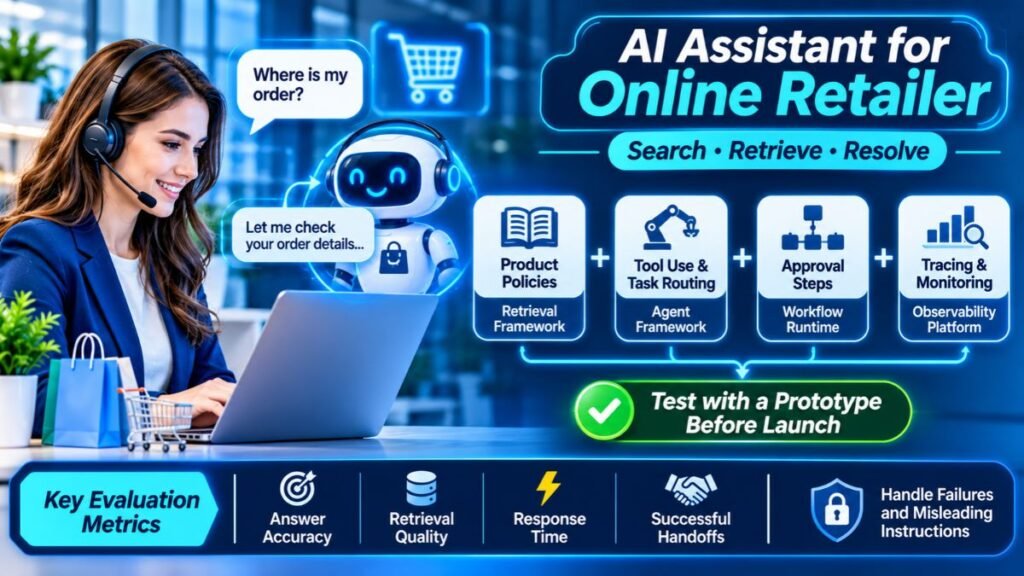
A retrieval-focused framework could manage product documentation, while an agent framework could handle tool use and task routing. The retailer might also need a workflow runtime for approval steps and an observability platform for tracing. A small prototype should test the full process before launch.
For this kind of project, the team should measure answer accuracy, retrieval quality, response time, and the rate of successful handoffs. It should also test what happens when an API fails or the model receives misleading instructions. These checks matter more than the number of available integrations.
Frequently Asked Questions
What is replacing LangChain?
Tools like LlamaIndex, CrewAI, Haystack, and Microsoft Agent Framework are popular alternatives, depending on the project’s requirements.
Is LangChain still popular?
Yes. LangChain remains widely used for building LLM applications, connecting tools, and developing AI agents.
What are the top alternatives to LangChain in 2026?
Leading alternatives include LlamaIndex, CrewAI, Haystack, Microsoft Agent Framework, Google ADK, OpenAI Agents SDK, and Mastra.
Is DSPy better than LangChain?
Not necessarily. DSPy focuses on optimizing language model pipelines, while LangChain provides broader tools for building LLM applications and agents.
Which LLM alternative?
If you mean an alternative to LangChain, consider LlamaIndex for RAG, CrewAI for multi-agent systems, or PydanticAI for structured Python agents.
For which of the following use cases would a tool like LangChain?
LangChain is useful for building AI chatbots, document question-answering systems, RAG applications, AI agents, and automated workflows.
Final Verdict: Which LangChain Alternative Should You Choose?
The right framework is the one that matches the application’s real requirements. LlamaIndex and Haystack are relevant for retrieval-heavy systems. CrewAI supports role-based collaboration, while Microsoft Agent Framework and Google ADK align with their respective cloud ecosystems. Mastra serves TypeScript teams, and PydanticAI supports typed Python development.
Before committing, build a small prototype with realistic data and tools. Measure response quality, retrieval accuracy, latency, operating cost, and failure recovery. Review the license and deployment model as well. A careful evaluation can prevent expensive changes when the application grows.
AI agents are becoming more capable, but reliable systems still need engineering discipline. Clear workflows, controlled permissions, useful evaluations, and human review remain important. Select a framework that helps your team build those safeguards instead of choosing one only because it has a long feature list.