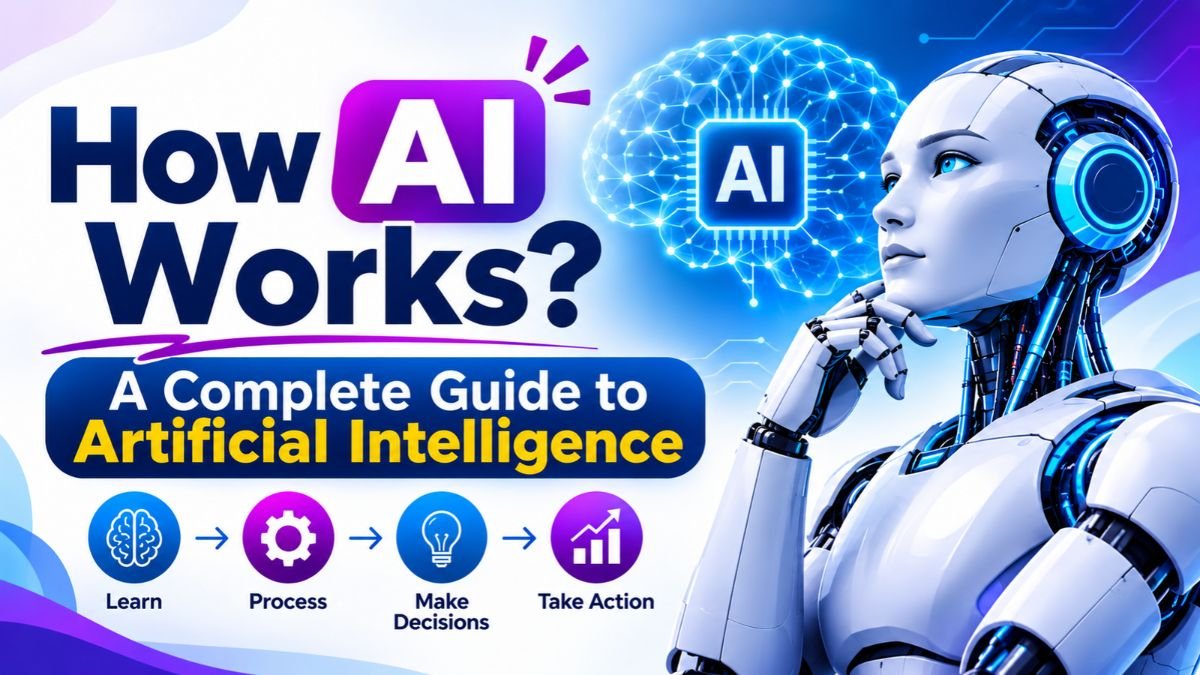
How AI Works? A Complete Guide to Artificial Intelligence
Artificial intelligence (AI) is changing how businesses, industries, and people solve everyday problems. From chatbots and virtual assistants to self-driving cars, AI systems can analyze information, recognize patterns, and make predictions with impressive speed. But how AI works is more than just a computer following instructions. It involves machine learning, AI algorithms, and large amounts of data that help machines learn from experience and improve their performance.
These technologies allow AI to understand language, identify images, automate tasks, and support better decisions. Understanding how AI works helps you explore its real-world applications, benefits, limitations, and growing role in modern life.
What Is Artificial Intelligence (AI)?
Artificial intelligence (AI) is a field of computer science that develops machines capable of performing tasks associated with human intelligence. These tasks include recognizing speech, understanding language, analyzing images, solving problems, and making predictions. The Artificial intelligence definition covers many technologies that help computers process information and respond intelligently.
Unlike traditional programs, which follow fixed instructions, many AI systems learn from examples and adjust their behavior through training. For example, an email filter can examine thousands of messages to identify spam. Over time, a properly trained model can recognize suspicious patterns that developers haven’t programmed individually.
AI doesn’t always think or understand information like a human. Instead, it uses mathematical methods to process inputs and calculate likely outcomes. Its performance depends on the training data, model design, available computing resources, and task requirements.
How Is Artificial Intelligence Different From Traditional Software?
Traditional software follows instructions written by developers. Every action depends on rules and conditions within its code. However, Machine learning allows a program to discover patterns from examples rather than requiring a separate instruction for every possible situation.
Consider an email spam filter. A traditional program might block messages containing specific words or addresses. An AI-powered filter examines several signals, including sender behavior, message structure, and suspicious links. This flexible approach helps it detect new spam patterns more effectively.
Why Is Artificial Intelligence Becoming So Important?
AI is growing because organizations can access larger datasets, faster processors, and affordable cloud services. These developments make advanced AI technologies available to companies of different sizes. Businesses can now analyze information that once required extensive manual effort.
According to Stanford’s 2026 AI Index, 88% of surveyed organizations reported using AI in 2025. This reflects the growing role of AI across business operations. Companies increasingly explore automation, customer support, research, and data analysis. Source: Stanford AI Index 2026.
How Does AI Work Step by Step?
How AI works becomes easier to understand when its main stages are examined separately. Most machine learning systems collect information, prepare datasets, select algorithms, and train models. After training, the system processes new information and produces predictions, classifications, or other outputs.
The process usually begins with data. Next, AI algorithms examine examples and adjust model parameters to reduce errors. Once developers test and deploy a model, it can handle new requests. Some systems also use Feedback loops to improve performance through evaluation and additional training.
Step 1: Collecting and Preparing Data
Every learning system needs information before it can perform a task. This information may include text, photographs, videos, audio recordings, or numerical records. These collections are called Data sets, and their quality strongly affects the model’s results.
Before training begins, developers clean and organize the information. They remove duplicate records, correct errors, and handle missing values. Some projects also require labeling, which means assigning correct categories to examples. This stage helps create reliable Training data for learning.
Step 2: Choosing Algorithms and Training Models
After preparing the dataset, developers select a suitable learning method. Different tasks require different mathematical approaches. For example, image classification needs different techniques from financial forecasting or language generation. During AI training, algorithms examine examples and adjust internal model parameters.
A model compares its predictions with expected answers during supervised training. It calculates an error score and changes its parameters to reduce that error. This process repeats across many training examples. Eventually, the model learns useful relationships that help it handle unfamiliar inputs.
Step 3: Recognizing Patterns and Making Predictions
Once training progresses, the system begins to identify patterns within the information. It may discover relationships between customer purchases, weather conditions, or financial transactions. These connections allow AI to recognize patterns that support classification and prediction.
For example, an online store can analyze previous purchases and browsing activity. Its recommendation model may make predictions about products a customer could enjoy. However, predictions represent calculated possibilities rather than guaranteed outcomes. Their reliability depends on relevant data and suitable model design.
Step 4: Testing, Inference, and Generating Results
Training alone doesn’t prove that a model will work reliably. Developers test it using information that wasn’t included in the original training process. This helps reveal over fitting, where a model performs well on familiar examples but struggles with new situations.
After testing, developers can deploy the model for Data processing and inference. Inference means using a trained model to analyze new information and generate an output. For instance, a chatbot processes your question and produces a response. This happens without repeating its entire training process.
Step 5: Improving Performance Through Feedback
An AI model may need updates after deployment. Developers monitor its accuracy, examine errors, and check whether real-world data has changed. These Feedback loops help teams identify weaknesses and decide when additional training or adjustments are necessary.
For example, a fraud detection system may encounter new payment patterns as criminals change their methods. Developers can evaluate recent performance and update the model with suitable examples. However, improvements require careful testing because new training can sometimes introduce different errors.
What Are the Main Technologies Behind Artificial Intelligence?
Modern AI combines several technical disciplines that help computers process information and solve complex problems. Machine learning, Deep learning, and Neural networks form important parts of this ecosystem. Other technologies help machines interpret language, recognize objects, and generate new information.

These technologies often work together rather than operating independently. A voice assistant may combine speech recognition, natural language processing, and machine learning. Similarly, an autonomous vehicle uses computer vision, sensor information, and prediction models. Understanding these connections explains how different AI applications operate.
Machine Learning (ML)
Machine learning is a branch of AI that allows computers to learn patterns from examples. Developers train Machine learning models using historical information instead of writing every decision as a fixed rule. The model then applies its learned patterns to new situations.
For example, Netflix-style recommendation systems examine viewing history, user preferences, and similar behavior. They use these signals to suggest relevant content. Machine learning also supports fraud detection, demand forecasting, product recommendations, and customer segmentation.
Deep Learning and Neural Networks
Deep learning is a specialized form of machine learning that uses multiple layers of artificial neurons. These layers process information in stages, allowing models to learn complex features. Deep learning supports image recognition, speech processing, language generation, and many advanced AI tasks.
Neural networks contain connected computational units that pass information between layers. Each connection has a numerical weight that influences the final result. During AI model training, the network adjusts these weights to reduce prediction errors. This process helps the model learn useful relationships within large datasets.
Natural Language Processing (NLP)
Natural language processing helps computers analyze and generate human language. It allows software to process written text, recognize spoken words, translate languages, and summarize documents. NLP supports virtual assistants, customer service platforms, and conversational applications.
For example, a voice assistant converts spoken language into digital information before interpreting a request. It can then search for an answer or perform an available action. Modern language models also use advanced NLP techniques to generate natural-sounding responses.
Computer Vision
Computer vision allows machines to interpret visual information from photographs and videos. AI models can identify objects, recognize shapes, examine images, and detect changes between visual frames. These capabilities support security systems, medical imaging, manufacturing inspections, and autonomous vehicles.
For example, a manufacturing camera can inspect products moving along an assembly line. A trained model identifies scratches, damaged parts, or unusual shapes. This helps workers detect quality problems faster and maintain consistent production standards.
Algorithms, GPUs, and Computing Infrastructure
AI depends on mathematical instructions and powerful hardware. AI algorithms define how models process information, learn patterns, and generate results. Graphics processing units, commonly called GPUs, perform many calculations simultaneously. This makes them useful for training complex models.
Computing power also depends on memory, storage, networking, and reliable electricity. Many organizations use Cloud computing to access computing resources without purchasing every server themselves. These resources form the foundation of modern AI infrastructure and support large-scale model development.
What Are the Different Types of Artificial Intelligence?
Artificial intelligence can be classified according to its capabilities and design. The most familiar capability-based classification includes narrow AI, artificial general intelligence, and artificial super intelligence. These categories describe how broadly a system could perform intellectual tasks.
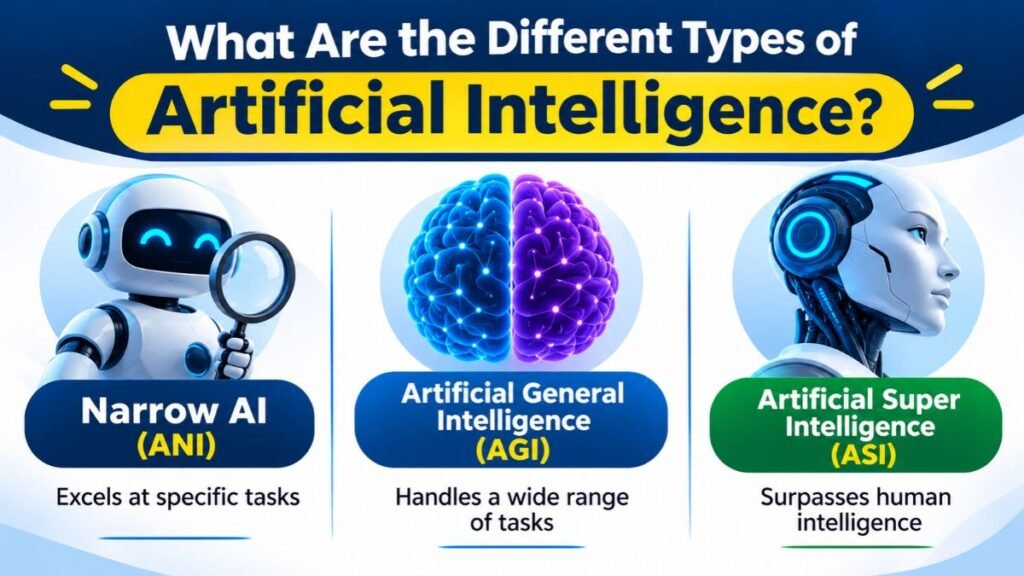
However, these categories don’t represent three equally developed technologies. Narrow AI already powers many commercial products and services. General AI and super intelligence remain theoretical concepts. Understanding this distinction helps separate current AI capabilities from predictions about future systems.
Narrow Artificial Intelligence (ANI)
Narrow AI performs specific tasks within a defined area. It can recognize faces, recommend products, translate text, or detect unusual financial transactions. Most commercial AI applications available today belong to this category.
A navigation application provides a useful example. It examines road conditions, traffic information, and available routes to suggest directions. Although it can perform this task efficiently, it doesn’t automatically gain the ability to solve unrelated problems.
Artificial General Intelligence (AGI)
Artificial general intelligence describes a theoretical system that could perform a broad range of intellectual tasks. Such a system would adapt knowledge across different situations rather than remaining limited to one specialized function.
Researchers continue exploring the technical and scientific challenges associated with AGI. These include flexible reasoning, reliable planning, learning from limited examples, and understanding unfamiliar environments. Current advanced models can handle many tasks, but broad performance doesn’t establish human-level general intelligence.
Artificial Super intelligence (ASI)
Artificial superintelligence describes a hypothetical system that would exceed human intellectual abilities across many fields. This concept appears in discussions about advanced computing, future research, and AI safety.
No verified artificial super intelligence currently exists. However, the possibility raises questions about control, accountability, and long-term safety. Researchers examine these concerns to understand how increasingly capable systems could remain aligned with human needs.
Other Common AI Categories
Other classifications describe how AI systems behave or perform particular tasks. Reactive systems respond to current inputs without storing previous experiences. Limited-memory systems use past information to support present decisions, while generative models create new content.
Predictive AI estimates likely outcomes from available information. Agentic AI can pursue defined goals through planning, tool use, and multiple actions. These categories describe different features and aren’t direct replacements for the narrow, general, and super intelligence classification.
How Does Generative AI Work?
Generative AI is a category of artificial intelligence that creates new content from patterns learned during training. It can produce written text, images, audio, videos, and computer code. Unlike conventional prediction systems, generative models create outputs rather than only assigning categories or estimating values.
Popular examples include ChatGPT and Google Gemini. These tools use advanced large language models (LLMs) and other machine learning techniques. Their responses depend on the prompt, learned parameters, available context, and system instructions. However, generated information still requires verification.
How Do Large Language Models (LLMs) Generate Text?
Large language models process text by dividing it into smaller units called tokens. A token may represent a complete word, part of a word, or punctuation. The model examines the surrounding context and estimates which token should come next.
Many modern language models use transformer architecture. Its attention mechanism helps the model weigh relationships between different tokens. This allows it to connect relevant information across a sentence or longer passage. The model then generates a response through repeated next-token predictions.
How Does AI Generate Images, Videos, and Audio?
Image generation systems often use diffusion models. These models learn to create images by gradually transforming random noise into meaningful visual content. A written prompt guides the process by describing objects, styles, colors, and other details.
Video and audio generation use related but different approaches. Video models must maintain visual consistency across frames, while audio models generate speech or sound patterns. These tools make AI-generated content useful for marketing, education, entertainment, and creative production.
What Happens When You Enter a Prompt Into ChatGPT?
When you submit a question, the system first converts your text into tokens. The model then processes those tokens alongside the available conversation context. Its internal calculations estimate likely continuations based on patterns learned during training.
Next, the system generates an answer token by token. Depending on the application, additional tools may retrieve information, run code, or perform other tasks. The final response appears as readable text. Clear prompts often improve relevance, although they cannot guarantee accuracy.
What Is the Difference Between Generative AI and Traditional AI?
Traditional AI often focuses on classification, prediction, and pattern detection. A fraud detection model may classify a payment as suspicious. A recommendation system estimates which product a customer might prefer. These systems usually produce decisions or scores.
Generative AI creates new material based on learned patterns. It can draft an email, generate an image, or write computer code. Both approaches can use machine learning and deep learning. The main difference lies in the output each system is designed to produce.
How Do AI Models Learn From Data and Make Decisions?
AI models learn by examining examples and adjusting their internal settings. During training, algorithms compare predicted results with expected outcomes. They then change model parameters to reduce errors. This process helps AI learns from data through repeated calculations rather than human-style understanding.
Different learning methods suit different problems. Supervised learning uses labeled examples, while unsupervised learning searches for hidden structures. Reinforcement learning uses rewards and penalties to guide behavior. These approaches influence how systems analyze information and support AI decision-making.
Supervised Learning
Supervised learning trains a model using examples with known answers. For instance, developers may provide thousands of labeled images showing cats and dogs. The model studies these examples and learns features that help distinguish between the two categories.
After training, the model can examine an unfamiliar image and estimate its category. This approach supports medical image classification, spam detection, and credit risk analysis. Its accuracy depends on representative examples and reliable labels.
Unsupervised Learning
Unsupervised learning works with data that doesn’t contain predefined answers. Instead, the model searches for similarities, differences, and hidden relationships. Clustering algorithms can group customers according to their shopping habits or purchasing behavior.
Businesses use this approach to understand customer segments and discover unusual activity. For example, a retailer may identify groups with similar buying patterns. These insights can support marketing decisions and inventory planning without manually labeling every customer.
Reinforcement Learning
Reinforcement learning trains an agent through actions and feedback. The agent observes its environment, selects an action, and receives a reward or penalty. Over repeated attempts, it learns which actions produce better outcomes.
This approach supports robotics, game-playing systems, and certain navigation tasks. A robotic system may learn how to move an object without dropping it. However, the training environment must reflect important real-world conditions to support safe performance.
How Do AI Models Improve Their Accuracy?
Developers improve models through testing, parameter adjustments, and carefully selected training examples. A loss function measures how far predictions differ from expected results. Optimization methods then adjust model parameters to reduce these errors across training examples.
Teams also examine accuracy, precision, recall, and other performance measures. They may use fine-tuning to adapt a pretrained model to a specific task. Human reviewers can identify harmful or incorrect outputs. Still, more training doesn’t automatically make every prediction correct.
How Does AI Work in Real-World Applications?
AI has moved beyond research laboratories and into everyday products and services. Real-world AI applications now support healthcare, finance, manufacturing, retail, transportation, and education. These Data-driven industries use models to analyze large amounts of information and improve specific processes.
The exact method depends on the problem. Healthcare systems may analyze medical images, while banks monitor unusual transactions. Retailers predict demand and personalize recommendations. In each case, AI processes relevant information and produces results that support workers, customers, or automated operations.
How AI Works in Healthcare
AI in healthcare supports medical imaging, patient monitoring, drug discovery, and administrative work. Image analysis models can identify patterns in X-rays, CT scans, and other medical records. These findings may help clinicians decide which areas need closer examination.
For example, a radiology team may use an AI system to flag suspicious areas in an image. A qualified professional reviews the result before making clinical decisions. AI can support medical work, but it doesn’t replace professional judgment or patient-specific evaluation.
How AI Works in Banking and Finance
AI in finance helps institutions monitor transactions, detect fraud, and assess financial risks. Models examine payment amounts, transaction locations, account behavior, and other signals. When an activity differs from expected patterns, the system may flag it for further review.
Banks also use machine learning for customer service and financial forecasting. For example, an unusual purchase may trigger a security check. However, financial institutions must consider privacy, fairness, accuracy, and regulatory requirements when using automated decisions.
How AI Works in Manufacturing and Supply Chains
AI in manufacturing supports predictive maintenance, quality inspection, and production planning. Sensors collect information about temperature, vibration, pressure, and machine performance. AI models examine these signals to identify conditions that may indicate equipment problems.
A factory can use predictive maintenance to schedule inspections before a machine fails. Computer vision can also identify damaged products on production lines. These systems help reduce waste, improve consistency, and support more efficient operations.
How AI Works in Retail and E-Commerce
AI in retail helps companies understand customer behavior and manage product availability. Recommendation engines examine browsing history, purchases, and product interactions. They use this information to suggest items that may interest individual shoppers.

Retailers also use demand forecasting to estimate future sales. These predictions can guide inventory planning and warehouse operations. However, personalized systems must respect customer privacy and avoid using sensitive information without appropriate safeguards.
How AI Works in Education and Transportation
Education platforms use AI to adjust learning materials according to student progress. An intelligent tutoring system can identify topics that need additional practice. Teachers can use these insights to provide more focused support and monitor learning needs.
Transportation systems use AI for traffic prediction, route planning, and vehicle perception. Autonomous driving technology combines cameras, radar, sensors, and machine learning models. These systems analyze road conditions and nearby objects. Safety testing remains essential before deploying such technology in public environments.
How AI Supports Cybersecurity and Business Automation
AI helps security teams detect suspicious network activity and unusual login behavior. Models can examine large volumes of system records to identify patterns linked with possible threats. Security professionals then investigate alerts and decide which actions are appropriate.
Businesses also use AI automation to handle repetitive workflows. Examples include document classification, appointment scheduling, invoice processing, and customer inquiries. AI-powered chatbots can answer common questions and direct complex requests to human employees. This approach supports intelligent automation across different departments.
What Are the Benefits of Artificial Intelligence?
Artificial intelligence offers practical advantages when organizations apply it to suitable tasks. It can process information quickly, reduce repetitive work, and help teams identify patterns across large datasets. These capabilities support better planning and more efficient operations in many industries.
The value of AI depends on the problem, available information, and quality of implementation. Well-designed AI solutions can improve customer service, support research, and reduce operational delays. However, organizations should measure actual results instead of assuming that every AI project will deliver savings.
Increased Productivity and Automation
AI can handle routine activities that consume valuable working hours. Examples include sorting documents, summarizing reports, organizing records, and answering common customer questions. Employees can then spend more time on tasks requiring judgment, communication, and creativity.
For small businesses, automation can simplify daily operations without requiring a large administrative team. A company might automate appointment reminders or classify incoming support requests. Proper review helps ensure that automated workflows remain accurate and useful.
Faster and More Informed Decision-Making
AI can examine large datasets and highlight relationships that may be difficult to notice manually. Predictive models help organizations estimate demand, identify risks, and compare possible outcomes. These insights can support planning and reduce delays in decision-making.
However, predictions aren’t the same as facts. Managers should consider the model’s assumptions, data quality, and possible errors. Combining AI analysis with human experience creates a more balanced decision process.
Cost Savings and Operational Efficiency
AI can help reduce costs by improving resource use and preventing avoidable problems. Predictive maintenance may reduce unexpected equipment failures. Automated document processing can also lower the time employees spend handling routine paperwork.
The initial investment still matters. Organizations may need software licenses, skilled workers, security controls, and computing resources. A realistic cost assessment should compare implementation expenses with measurable improvements over time.
Better Customer Experiences and Personalization
Recommendation systems help customers discover products, services, and information that match their interests. Conversational assistants can also provide quick answers outside normal business hours. These features can make digital services more convenient.
For example, an online store may recommend products based on previous purchases. A support chatbot may explain order status or return procedures. Companies should provide clear options for human assistance when automated responses cannot resolve a problem.
Innovation Across Industries
AI supports new research methods and business services. Scientists can use models to examine complex datasets, explore molecular structures, and identify promising research directions. Engineers can also use AI tools to test ideas and accelerate certain development tasks.
In creative industries, generative systems help produce early drafts, visual concepts, and prototypes. Professionals can review and refine these outputs. This combination of human expertise and AI support can open new paths for innovation.
What Are the Limitations and Risks of AI?
Despite its advantages, AI has important weaknesses. Models can produce inaccurate answers, reflect unfair patterns, or expose sensitive information. Their outputs may also become unreliable when real-world conditions differ from training examples. These AI limitations deserve attention before organizations depend on automated results.
Responsible deployment requires testing, security, transparency, and human oversight. The Ethical implications of AI become especially important when systems affect healthcare, employment, lending, education, or public services. Organizations should evaluate potential harm throughout development and everyday use.
AI Bias and Unfair Decision-Making
AI models can reproduce unfair patterns found in their training information. For example, a hiring model trained on biased historical records may favor certain applicant groups. A facial recognition system may also perform differently across demographic groups.
Developers should examine training datasets and evaluate results across relevant populations. Regular testing can reveal unequal error rates. Human review is also important when an automated recommendation could affect someone’s opportunities or rights.
Data Privacy and Cybersecurity Risks
AI applications may process personal, financial, medical, or business information. If organizations collect more data than necessary, they increase privacy risks. Poor security practices can also expose sensitive records to unauthorized users.
Companies should limit access, protect stored information, and review how external AI services handle submitted data. Employees should avoid entering confidential material into tools that haven’t been approved for that purpose. Security policies need regular updates as technology changes.
AI Hallucinations and Inaccurate Information
Generative models sometimes produce answers that sound convincing but contain false details. This behavior is commonly called an AI hallucination. A chatbot might invent a source, misstate a date, or provide an incorrect explanation.
The problem occurs because language models generate likely sequences rather than automatically verifying every statement against trusted evidence. Users should check important claims using reliable sources. This is especially important for medical, legal, financial, and safety-related information.
Job Displacement and Workforce Challenges
Automation can change how employees perform their jobs. Some routine tasks may require fewer manual hours, while new responsibilities emerge around AI management, data quality, and system evaluation. The effects vary across industries and occupations.
Workers can prepare by developing digital literacy, communication, analytical thinking, and technical skills. Employers should also consider training programs when introducing automated systems. A thoughtful transition can help employees adapt to changing workplace requirements.
High Computing Costs and Environmental Impact
Advanced AI models require powerful processors, memory, storage, and network connections. These resources operate inside Data centers, which need reliable electricity and cooling systems. Their construction and operation create costs beyond the software itself.
The International Energy Agency reported that global data center electricity consumption increased by 17% in 2025. Its analysis projects that consumption could nearly double between 2025 and 2030. AI-focused facilities are a major part of this growing demand. Source: IEA, Key Questions on Energy and AI.
Why Human Oversight and Responsible AI Matter
Responsible AI means developing and using systems with attention to safety, fairness, privacy, transparency, and accountability. Human oversight helps identify problems that automated checks may miss. It also creates a clear process for reviewing important decisions.
The National Institute of Standards and Technology provides an AI Risk Management Framework. It helps organizations identify, assess, and manage risks throughout the AI lifecycle. Such guidance can support safer adoption across industries.
What Is the Future of Artificial Intelligence?
The future of AI will likely involve more capable models, wider automation, and deeper integration with everyday software. Researchers continue improving reasoning, multimodal processing, robotics, and language generation. At the same time, organizations must address safety, infrastructure, and workforce challenges.
AI adoption will depend on more than technical progress. Businesses need reliable data, skilled employees, clear policies, and suitable infrastructure. As AI development advances, the strongest results will come from matching each system’s capabilities with a well-defined problem.
The Rise of AI Agents and Autonomous Systems
AI agents are designed to complete tasks through multiple steps. They may interpret a goal, create a plan, use digital tools, and review the results. For example, an agent could organize research, summarize documents, or prepare information for a customer support team.
These systems can reduce manual work across connected applications. However, they need clear permissions and limits. Organizations should monitor actions that affect money, private records, customer accounts, or important business decisions.
AI and the Future of Work
AI may change the tasks people perform across many occupations. Administrative workers may use assistants to prepare reports, while analysts may automate parts of data review. Software developers can use AI coding tools to generate suggestions and identify possible errors.
Human skills will remain important in areas requiring judgment, empathy, leadership, and accountability. Workers who understand how AI tools operate can evaluate their outputs more effectively. Continuous learning will help professionals adapt as workplace technology evolves.
Advances in Robotics and Multimodal AI
Multimodal AI can process different forms of information, including text, images, audio, and video. This allows a system to connect details across several input types. For example, a model could analyze a photograph alongside a written question.
Robotics can combine these capabilities with physical sensors and movement controls. A robot may identify an object, estimate its position, and plan an action. Such systems could support warehouses, manufacturing facilities, healthcare environments, and other specialized settings.
Responsible AI Development and Regulation in the United States
The United States continues to develop policies and guidance for AI safety, privacy, and accountability. Federal agencies, state governments, and industry groups address different parts of this changing landscape. Requirements can vary depending on the application and jurisdiction.
Businesses should monitor relevant laws and sector-specific rules before deploying AI systems. They should also document how models work, protect sensitive data, and test potential risks. Responsible development supports public trust and reduces avoidable harm.
Will Artificial Intelligence Replace Human Intelligence?
AI can perform many tasks that once required significant human effort. It can summarize information, recognize images, generate content, and analyze large datasets. However, these abilities don’t mean machines possess human experiences, emotions, or consciousness.
People bring social understanding, personal responsibility, and knowledge of real-world situations. AI can support decisions, but humans must evaluate its outputs and consequences. The future will likely involve different levels of collaboration between people and increasingly capable machines.
Conclusion: Understanding How Artificial Intelligence Works
Artificial intelligence combines data, algorithms, and computing resources to perform tasks that often require human intelligence. Machine learning helps systems recognize patterns, while deep learning supports complex tasks involving language, images, and sound. Generative models extend these capabilities by creating new content.
Understanding How Does AI Work? Helps people make better choices about using this technology. It also makes it easier to recognize its limits and evaluate its results. From healthcare and finance to retail and manufacturing, AI continues to influence how organizations operate.
However, successful AI use requires reliable data, careful testing, privacy protection, and human oversight. As technology advances, responsible development will become increasingly important. Learning how these systems work today can help individuals and businesses prepare for tomorrow’s opportunities.
Frequently Asked Question
How does AI work step by step?
AI collects and processes data, identifies patterns, learns through algorithms, and uses trained models to make predictions or generate results.
What three jobs will not be replaced by AI?
Jobs requiring human judgment, empathy, and physical adaptability, such as nurses, therapists, and skilled electricians, are less likely to be fully replaced.
What are the 5 things AI can’t do?
AI cannot genuinely feel emotions, understand human experiences like people do, guarantee accurate information, take full moral responsibility, or independently replace human judgment in every situation.
What is exactly AI and how does it work?
Artificial intelligence is technology that enables machines to perform tasks associated with human intelligence. It works by processing data, learning patterns, and generating predictions, recommendations, or decisions.
What jobs will AI eliminate in 5 years?
AI may reduce demand for some routine roles, including data entry clerks, basic customer support agents, transcriptionists, and certain administrative positions. However, the extent of job losses remains uncertain.
Meta Description
Discover how AI works, from machine learning and data processing to real-world applications, benefits, and future possibilities.